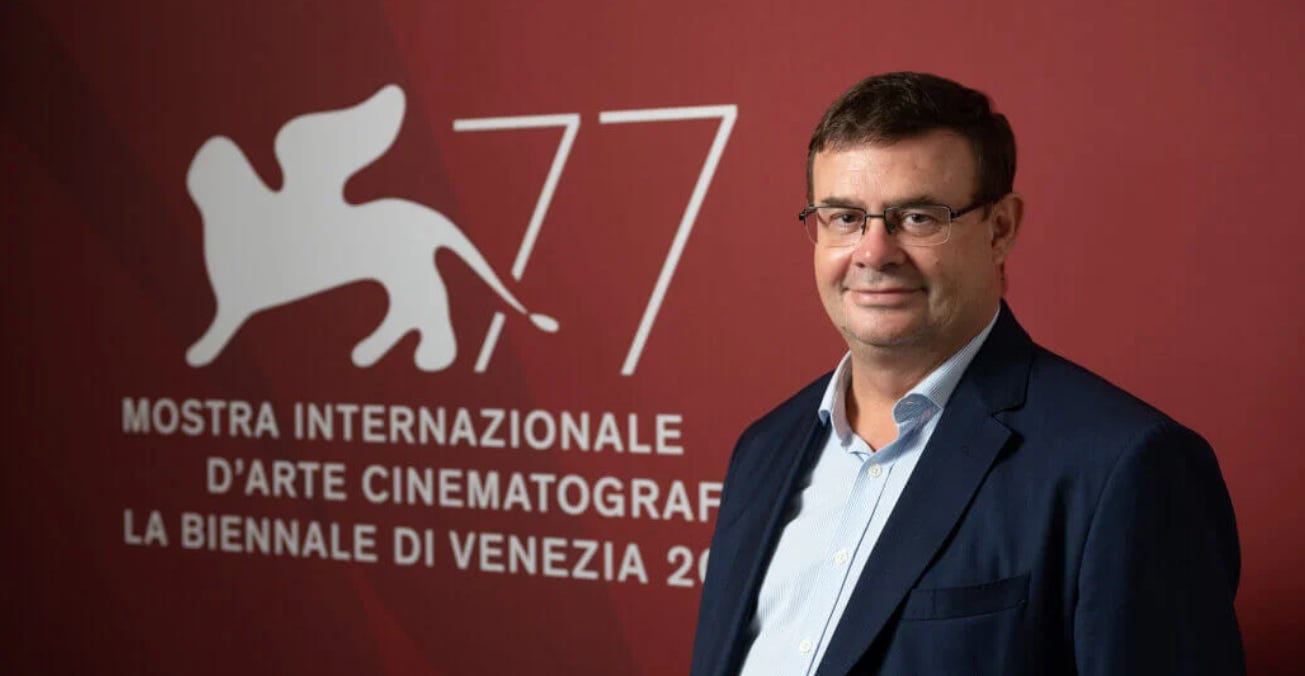
What led you to create a production-centered market in Venice?
Pascal Diot: When Alberto Barbera was reappointed as artistic director of the Venice Film Festival at the end of 2011, I was running the Dubai Film Market. We already knew each other — I used to attend Venice regularly as a sales agent and had met him often during his first tenure as director from 1998 to 2001.
When he got the job again, I called to congratulate him, and he shared his vision of launching a market alongside the festival. He asked if I’d take it on, given my familiarity with Venice. I proposed we do something different from Cannes or Berlin: a market specifically focused on production and producers.
That’s how the Venice Production Bridge was born. The name reflects our mission — to offer producers a full pipeline to develop, finance, and connect their projects, whether film or series.
How many participants are you expecting this year?
Roughly the same as last year — about 3,300 — though we’re seeing a slow upward trend. But I don’t ever want to exceed 3,500. Growth for its own sake doesn’t interest me.
What may seem like a drawback — Venice being an expensive city — is actually an asset. Companies only send key decision-makers, not huge delegations. That means one-on-one meetings go straight to the point. You get a yes or a no — no waiting around.
What’s new in the 2025 edition?
Many professionals asked us for more time to attend our different programs. Everything was crammed into four or five days, and it was hard to be everywhere. So this year, we’re extending the market by one day to allow for a better schedule balance.
We’re also expanding our country spotlights. Until now, we’d highlight one European and one non-European country. This year, we’re spotlighting three: the UK, Morocco, and Chile. When a country is featured, it’s represented across all programs — from the Gap-Financing Market to Final Cut and the Book Adaptation Rights Market. It’s a unique opportunity for visibility on an international scale.
The Production Bridge also features streamers prominently. What’s their role today?
Yes — our Meet the Streamers initiative, previously called VoD Market Day, gathers around 10 to 15 platforms. These range from global giants like Amazon, HBO, and Netflix to more niche players like WeShort, which specializes in shorts.
Today, many of them are moving into co-production, trying to secure early windows and gain leverage with producers. We also organize meetings between streamers and publishers, since platforms are constantly on the hunt for new IP.
What kind of content are platforms prioritizing?
They're driven by subscriber satisfaction and growth, so naturally they’re leaning toward more commercial content. But interestingly, they’re also investing more in documentaries — both feature-length and series formats.
Big players like Federation and Mediawan are working across all formats — cinema, streaming, and broadcast — so the lines are blurring. But this shift is widening the gap: on one end, we have auteur cinema; on the other, hyper-commercial films. The “middle ground” films are disappearing — they either end up as TV movies or platform releases.
Another trend we’ve seen grow: more and more films are adaptations. At the Oscars this year, over 30% of nominated films were based on books. For platforms and TV networks, adapting a known property gives a built-in marketing edge. The audience is already familiar with the material, which makes it easier to sell.
Every year, around 60 publishers apply to participate in our Book Adaptation Rights Market, and we select 30 of them. On average, seven to ten book rights deals are signed during the event.